BCALA Asked and I Answered

The Black Caucus of the American Library Association (BCALA) asked the candidates for ALA President to answer a few questions in advance of attending their Membership Meeting at the ALA Midwinter Meeting. I greatly enjoyed attending BCALA’s National Conference of African American Librarians this past fall (my reflections) and look forward to our continued conversations.  I welcome questions from other ALA groups and members as well. Please be in touch!  Lisa

BCALA Questions/Lisa’s Answers:

  1. In what concrete ways can – and will – you support the equity, diversity, and inclusion initiatives of the ALA, especially with respect to having greater representation of diverse voices “at the table” in leadership and decision-making roles?

Like many others, I look forward to the plan and strategic actions that are forthcoming from the ALA Task Force on Equity, Diversity, and Inclusion (http://www.ala.org/groups/task-force-equity-diversity-and-inclusion). The conversations that the Task Force has hosted as well as its other activities have already raised awareness and laid the foundation for future action. What we must do though is to actually take action. As ALA President, I will work to ensure that the report from the Task Force is a living document – one that drives change, inspires us to do better, and helps us find our way when we fail to live up to our goals. As ACRL President, I led an effort to create a new Strategic Plan for the division, which was then realized through alignment of resources, planning, and assessment. Equity, diversity, and inclusion deserve and will receive that same careful attention.

More concretely – let me refer to my Candidate Statement:

“Many in ALA have worked to identify and eliminate practices of exclusion; however, an ethos of hospitality requires more. We must also create and support practices of inclusion. It is not enough to remove barriers; we must also build bridges. We must intentionally create space for diversity to strengthen ALA as an inclusive and collegial community of practice.” (https://lisahinchliffe.com/2015/12/15/ethos-of-hospitality/)

As stated, I will charge my appointments committee to appoint at least one person who has not previously served on an ALA committee to each committee. I took this approach as ACRL President and welcomed many newer members of the profession into leadership positions and increased the diversity of committee membership. In addition, I have promised to commit funds to support practices for digital inclusion in order to bring all voices to the table for conversations, decision-making, and engagement. I cannot be satisfied with an association that only engages conference attendees.

Finally, above all, I will listen. I will ask questions. I will converse. I cannot rely on my own privileged experience as my only guide. As ALA President, I promise to create space for diversity and to champion inclusion. That is the ethos of hospitality I will bring to the association.

  1. How do you envision the ALA working more closely with the Ethnic Affiliates?  In what specific ways could there be greater collaboration?

I’m going to refer again to the ALA Task Force on Equity, Diversity, and Inclusion and its forthcoming recommended plan and strategic actions. Given ALA has this task force, I think role of the next ALA President is to champion the work of this group that has put in a great deal of time and effort to engage the membership, study the issues, and identify next steps. But, I will offer a thought for consideration – I think there is a great potential for greater collaboration between the Ethnic Affiliates and groups within the Divisions and Roundtables. I myself have served as a mentor in the ACRL Dr. E. J. Josey Spectrum Scholar Mentor Program (http://www.ala.org/acrl/membership/mentoring/joseymentoring/mentorprogram) – one mentee relationship is getting near to a decade long now. It would be great to see more engagement across ALA with the Ethnic Affiliates.

  1. Data from ALA shows that the number – and percent – of librarians from traditionally underrepresented groups (TUG) has declined over the past 10 years.  We recognize that there are fewer librarian positions now, but to what might you attribute the sharper decline in the number of TUG librarians, and what role should ALA play in trying to reverse that trend?

This is such a troubling trend. Chris Bourg, MIT Director of Libraries, wrote a very informative blog post on the lack of diversity in the profession (https://chrisbourg.wordpress.com/2014/03/03/the-unbearable-whiteness-of-librarianship/) and included thoughtful analysis of the recruitment efforts we would need for the profession’s racial diversity to match that of the United States. The data are sobering. But, I’m also concerned – based more on personal observation and conversations (since the research base is still developing on these topics) – that the profession also needs to look hard at issues related to retention. Librarians have skills that they can use in many different settings. Are we making certain that libraries are the workplace of choice because they are workplaces of diversity, equity, and inclusion? ALA has a useful guide on Recruitment for Diversity (http://www.ala.org/advocacy/diversity/workforcedevelopment/recruitmentfordiversity) – a companion piece on retention and another on diversity leadership would be most useful.

  1. As we examine the need for more diverse books, it has been commented upon that the awards committees within the divisions also lack a true understanding and appreciation of the diverse books that are being written for children of color. As President, what would you do to assist in ensuring that more than “one” person of color serves on committees such as the Newbery (15), Caldecott (15), Alex (9), Sibert (9), and the like.  (It should be noted that the Coretta Scott King award has at any given time 2-3 people serving who are not African American and it is only a 7-member committee).

As the question acknowledges, these are awards given by ALA Divisions or Roundtables, so the ALA President has little power to make changes directly. However, I believe that are opportunities to lead and influence on this issue and many others across the Association. As ALA President, I will meet regularly with the Division Presidents and other leaders who are elected this spring over the coming three years. In these meetings I will lead discussions of diversity and equity and challenge them to join me in creating an ethos of hospitality and inclusion. Under my leadership, I believe we can work together and support each other in developing more inclusive practices and strategies. Ensuring representative composition of award committees is important and a good example of the broader set of arenas where the ALA President can set a tone and an expectation of diversity and inclusion.

An Ethos of Hospitality (Candidate Statement for American Libraries)

Each candidate for ALA President is given the opportunity to submit a one-page statement for the March/April issue of American Libraries. I am grateful to everyone who engaged in conversations with me in person, via Facebook, and on Twitter to share their hopes and concerns about the association. I look forward to hearing more – whether about the specifics I have put forth here or on other topics.


Lisa Janicke Hinchliffe

“creating an ethos of hospitality that welcomes all members
and removes barriers to participation”

My theme “Colleagues Connecting Communities” reflects what we do in our libraries and represents the work of ALA. I am very proud of ALA and the work that we do together as colleagues. We have a strong Code of Ethics that guides our practice. We are an influential force in policy-making. We engage important conversations around privacy and intellectual freedom. We are leaders in using technology to advance access to information.

By joining together as a community of colleagues, we accomplish more than we can alone. We raise the visibility of the impact that libraries have in our communities. We challenge each other to innovate and transform our practices. We support each other. We are strong.

But, we can be stronger. ALA is the oldest and largest library association in the world. ALA should also be the most engaged library association in the world. Unfortunately, we have many talented members and non-members who are not yet engaged in our collective work.

ALA must be a platform for participation and empowerment. My focus will be on creating an ethos of hospitality that welcomes all members and removes barriers to participation across the association.

Many in ALA have worked to identify and eliminate practices of exclusion; however, an ethos of hospitality requires more. We must also create and support practices of inclusion. It is not enough to remove barriers; we must also build bridges. We must intentionally create space for diversity to strengthen ALA as an inclusive and collegial community of practice.

To begin, here are four specific actions to build the ethos of hospitality that you can expect from me:

  1. I will charge my appointments committee to appoint at least one person who has not previously served on an ALA committee to each committee. I took this approach as ACRL President and welcomed many newer members of the profession into leadership positions and increased the diversity of committee membership.
  2. I commit to using ALA President funds to support promising exemplars of digital inclusion and to share those practices across the association.  ALA policy has been revised to allow the association to conduct its work virtually; however, many of our practices reflect historic reliance on in-person meetings. These practices exclude members who are unable to travel to ALA conferences for financial, health, work, etc. reasons. We can do better.
  3. I will re-engage the vision of previous ALA President Mitch Freedman for the ALA Allied Professional Association (ALA-APA). Library workers need a strong organization to advocate for improved wages, benefits, etc. As ALA-APA President, I will be a strong voice for library workers and seek to grow the influence of ALA-APA.
  4. I believe that ALA must re-examine the long-term viability of holding two conferences each year and the effect of doing so on member engagement and on the ecosystem of division and state chapter conferences. As ALA President, I will bring to the Executive Board a proposal for a task force on the future of ALA conferences to systematically and inclusively consider this topic.

As your ALA President, I will be a passionate voice for libraries and library workers, for dismantling exclusion, and for pursuing an ethos of hospitality and inclusion.  I welcome the opportunity to lead ALA and ALA-APA. We are a strong community of practice that can be made stronger. I ask for your vote.

Reimagine/Reinvent: Thoughts for ALA from Listening at the CLA Conference

This past weekend I had the opportunity to attend the California Library Association “Reimagine/Reinvent” Conference as a candidate for ALA President. I spent most of the time at an information table in the exhibiLisa at #CLAReimagine CLA ts hall, talking with CLA members/conference attendees and listening to their thoughts on libraries, their work, and the role of ALA. It was exciting to learn about all of the different library types and their communities. I am grateful that so many people took time to speak with me.
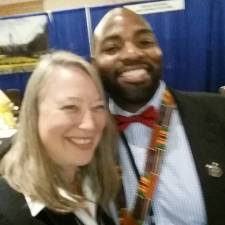
I heard many comments about the great work that ALA does and its valuable programs and conferences. Unfortunately, I heard even more about the challenges of getting access to those resources and the barriers to participation in ALA. For some, membership itself is out of reach because of the cost of dues. For others, they are members but cannot attend in-person because, as one quipped, “if I go to a conference, the library closes!” And, even for those who do attend, finding their place can be a challenge.

I left CLA ever more resolved in my vision of full participation in ALA. Imagine if everyone in libraries was an engaged member of ALA. We’d be unstoppable in our advocacy for our libraries, those who work in libraries, and our communities!

Figuring out how to overcome the financial barriers to membership will not be easy; we are going to need to work hard on that since dues are an important revenue source for funding our wonderful ALA activities.

At the same time, financial barriers to membership are not absolute barriers to participation. As ALA moves to making more resources openly available, ALA strengthens the library community and expands our reach and inclusion. I believe, however, that we can do more. And, really, we must do more. If we do not, we will always fall short of our goal of inclusion because we will always be missing the participation of some of our colleagues. We cannot settle for that.

In 2006, I served on the Subcommittee on e-Participation of the ALA Committee on Organization. The subcommitte was charged:

To identify the benefits of various kinds of potential e-participation; survey emergent e-participation practices in the general library association field, including ALA divisions and units; review and research background documents, including existing Association policy, with especial attention to the meaning and purpose of the Association’s open meeting policy; identify goals; explore possibilities; and report back to COO with findings and recommendations.

Though the notes from those discussions have a certain quaintness about them a decade later, what still resonates today are the purposes for our work, articulated in the report of the follow-on ALA Task Force on Electronic Member Participation: increase opportunities for ALA members to participate in the business of the organization, derive benefit from their membership, and enable ALA members for whom (for whatever reason) travel is a hardship, to participate more fully in the business of the organization, or to partake of its offerings (2008-2009 ALA CD #35).

ALA has definitely made progress in the past years on electronic member participation but technology continues to evolve and enable new possibilities. I think the time has come to be a “virtual first” organization. Let’s switch the default and assume that all groups will work virtually and only meet in person as needed. Let’s switch the default and welcome any committee member who wants to contribute and not just those who are able to attend Midwinter Meeting/Annual Conference. Let’s switch the default and presume that all conference programs will be recorded and, if not streamed live, available as part of a virtual conference package for later viewing. Many of ALA’s divisions and roundtables have pioneered innovative practices in these areas. Now is the time to make them common across the entire association and Reimagine/Reinvent member participation in ALA.

The ALA Executive Board at Work

One of the roles as ALA President is to serve on the ALA Executive Board, along with the other officers (Vice-President, Past-President, and Treasurer) and elected members of ALA Council. It is a hard-working group – with lengthy meeting agendas – that convenes not only at conference but also two additional times per year (plus participating in a number of conference calls). It is an impressive schedule of meetings [PDF]!

As I have not previously served on the ALA Executive Board, I was pleased to be able to observe the meeting in Chicago this weekend. The group had a very full agenda [PDF]. Much of the meeting was devoted to governance and oversight roles, particularly with respect to budget and finance, fund-raising, planning, nominating/elections, and conference scheduling.  The Board, however, also spent significant time on the ALA Strategic Directions: Advocacy [PDF], Professional and Leadership Development [PDF], and Information Policy [PDF]. I found the reports provided by the staff members working in each of these areas highly informative.

I was also excited to see a demo of the new responsive design for the ALA website and hear an update on Libraries Transform, ALA’s recently-launched, multi-year campaign which aims to “increase public awareness of the value, impact and services provided by libraries and library professionals.”  Given my work as ACRL President (2010-2011) on The Value of Academic Libraries Initiative, it will not surprise anyone to hear that I am thrilled with the message framing in Libraries Transform!

I also took special note of the report on “Membership: Making ALA More Welcoming” – which is one of my priorities. I believe ALA needs to serve as a platform for members to engage and build the future of the library community; however, I know that it is a large and complex association and that not everyone has a positive experience when they join. A number of great efforts are underway. I believe we can continue to improve in this, particularly through the affordances of technology that mean that member engagement is no longer restricted to face-to-face meetings. I’ll be talking more about this as a candidate for ALA president.

The Board also met in Executive Session to discussion honorary memberships, conduct an evaluation of the ALA Executive Director, and consider a report from an Accreditation Appeal Review Committee. As these sessions were closed, I got a few breaks to check email and stretch that the Board members did not.

Finally, the ALA Executive Board is also the Board of the ALA-APA (Allied Professional Association), the organization for the advancement of library employees. While I read the ALA-APA Library WorkLife newsletter, I appreciated this opportunity to learn more about the plans for how this group is moving forward.

All in all, it was a very interesting and educational experience for me to observe the Board at work. I want to thank Sari Feldman, current ALA President, for her warm welcome and to take a moment to acknowledge the ALA Governance Office staff who do a great deal of work in the background to ensure that these meetings run smoothly and efficiently.

Some Thoughts on School Libraries and Librarians (IFLA Satellite, August 2015)

As an academic librarian, I’ve long been interested in K-12 education and how students are prepared for success in college and in life. As I have always worked in academic libraries at institutions that educate future teachers, I’ve also worked to ensure that future teachers understand the potential of partnering with their school librarians.

When I worked at Illinois State University, I founded the Central Illinois Library Instruction Group to bring together librarians concerned with student learning from K-College. During the two or three years that the group met, I became even more aware of just how challenging the school library sitution is in our state. Unfortunately, I know that the Illinois story is not unique in the United States. In spite of clear evidence that school libraries with a trained school librarian contribute to student success, school libraries continue to struggle for funding, staffing, and legitimacy, especially as technology makes information content accessible online. From my service on the ALA OITP Digital Literacy Task Force, as well as the ALA School Library Implementation Task Force appointed by then-ALA President-Elect Barbara Stripling, I also know that working together across library types helps to strengthen support for school libraries and to amplify the message of the importance of school libraries.

These reflections are prompted by the opportunity I had to attend the IFLA Satellite Conference on School Libraries & Guided Inquiry: Taking Stock & Taking Action in Cape Town, South Africa. The event was co-sponsored by IFLA’s School Libraries and Information Literacy Sections and as a member of the Information Literacy Section Standing Committee I was pleased to be able to participate as a delegate in the meeting.

The keynote speaker, Cameron Dugmore, presented an exciting vision for school libraries in the Western Cape, but the follow-on panel made clear how many challenges exist for bring that vision to reality. Ross Todd, LIS professor from Rutgers, spoke in the afternoon and reminded us all that “no is not an answer if we want to move forward.” The attendees were noticably lifted in spirits by Ross’ can-do attitude and passion for the importance of their work. On the second day of the conference, attendees could attend one of two workshops related to guided inquiry – one focused on curriculum integration and the other on digital technologies.

The challenges faced by school libraries and librarians have many commonalities across the globe. Coming together to share stories of obstacles, strategies, and successes is just one way to build the school library community of practice.

National Conference of African American Librarians (August 5 – St. Louis)

My debut conference as a candidate for ALA President was the 9th National Conference of African American Librarians (NCAAL). No one can be involved in all parts of ALA and I believe that an important part of standing for election is engaging with colleagues in other parts of ALA in order to learn about their ideas and priorities.

11779968_10105343280724410_8208050733325202603_o.jpg
With Kelvin Watson, BCALA President

I want to thank Kelvin Watson, President of the Black Caucus of the American Library Association (BCALA), for warmly welcoming me, and Makiba Foster and Emily Guss, co-chairs of the conference planning committee, who led an impressive team that put on an outstanding event. And, not only was the conference outstanding – it was also imbued with a sense of fun and celebration!

The conference program was filled with thought-provoking sessions and speakers. Let me highlight a few:

Dr. Tukufu Zuberi, professor at University of Pennsylvania and a host of the PBS Series, History Detectives, gave an inspiring opening keynote on themes of coming to see the unseen and and naming the unnamed. The passion he displayed for his work is to me an example of what it means have life purpose and enjoy engaging with it. I’d love to invite him to speak at an ALA conferences and share more broadly his thoughts on equity and inclusion.

The panel discussion “Ferguson One Year Later: Community Perspectives – Lessons Learned” began with a presentation by Makiba Foster of a video sharing BCALA’s choosing to keep the NCAAL conference in St. Louis after the events in Ferguson. BCALA demonstrated by example – particularly in its response to the vandalism to the memorial tree that BCALA had dedicated in memory of Michael Brown, Jr. It is worth taking time to read the public statement issued by BCALA. Willie Miller covered the NCAAL Conference for American Libraries and his write-up of the details of the panel presentation is also worth reading. One of comments that is sticking with me was from Scott Bonner, director of the Ferguson Public Library, who reminded us all that “there’s no need that is too great for a library to do its best with.”

The final session that I was able to attend was “An Open Conversation with the ALA Task Force on Equity, Diversity, and Inclusion: Planning for Orlando and Beyond.” The charge of the Task Force states:

The Task Force on Equity, Diversity, and Inclusion will develop a plan and strategic actions to build more equity, diversity, and inclusion among our members, the field of librarianship, and our communities.  The most important Task Force outcome is the public and honest conversation that will be generated by its plan and recommended actions.

Session co-facilitators Trevor Dawes and Andrew Jackson hosted drew out from participants a number of ideas and questions that can inform the Task Force’s recommendations. The conversation also included individual librarians sharing their experiences of isolation and other struggles within the profession. Though these issues are troubling, I also noted a forward-looking and we-can-make-this-better-together tone, which I believe bodes well for our shared commitment to addressing the issues that need addressing in order to move towards the vision of true equity and inclusion. I shared my own thoughts about how ALA needs to use technology to be more inclusive of those who are not able to attend conference and those who work in and for libraries but are not members. I was heartened to hear that this was supported by participants in the discussion and, after the discussion, I had individual conversations with a number of people who wanted to help move forward such efforts.

Finally, I want to thank the NCAAL conference planning committee for the wonderful opening reception, which featured a performance of the gripping “Sweet Jenn: A Living Exhibit” performed by Lakeetha Blakeney of Redeeming History Theatricals, as well as art fair featuring local St. Louis artists plus a DJ and some great dancing. A celebration of friendship, the arts, and library colleagues!

Standing for Election

Being a candidate for ALA President is a great honor. I’ve already heard from so many people, sharing their hopes and aspirations for the association and how they would like to contribute over the coming years. It is inspiring to listen to the enthusiasm and vision and to learn about the great variety of libraries and the communities that they serve. Over the coming months I’ll have the opportunity to visit conferences and engage in virtual sessions as well as talk one-on-one with hundreds of colleagues and engage on social media  (http://twitter.com/lisa4ala and https://www.facebook.com/lisa4ala). I look forward to engaging with everyone and working together to create our future together.